
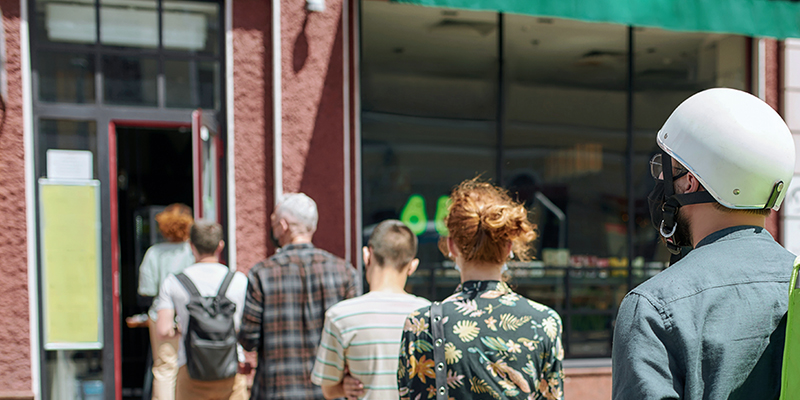
This isn’t a bad day. For a lot of operators, it’s a usual Tuesday.
The front end got faster, but the handoff didn’t.
Over the past several years, restaurants have made major investments in digital ordering, mobile apps, and kitchen efficiency tools. Orders get placed faster. Food gets made faster. But the moment of pickup, getting the order into the right person’s hands, has stayed largely the same. That gap is where the bottleneck lives.
As order volume increases, so does pressure on pickup. Staff get pulled away from food prep to answer questions, track down missing orders, or handle mistakes. Customers crowd pickup areas, unsure where to go or whether their order is ready. Delivery drivers add to the congestion. Small disruptions compound quickly, and what should be a smooth close to the customer experience becomes the weakest link in the operation.
Once the order leaves the kitchen, operators are flying blind.
A major contributor to this problem is the lack of visibility within the pickup process. Once an order is marked complete, many operators have no clear way to track how long it sits before being picked up, whether it was handed to the correct person, or how delays are affecting service times. Without that data, it’s difficult to identify where things go wrong, let alone fix them.
Customers feel it too. Many arrive at the designated time only to find their order isn’t ready. Or worse, it’s sitting somewhere disorganized or inaccessible. Some show up early to avoid the uncertainty, which just adds to crowding. Others check in repeatedly with staff, creating more interruptions. And orders prepared too early sit too long, compromising food quality. It’s a cycle that’s hard to break without a better system.
The “free” solution that isn’t at all free.
Open pickup shelves and handoffs at the counter are easy to implement and require little to no upfront investment. That makes them appealing, especially for operations trying to scale quickly. But every wrong pickup means a remake. Every staff interruption reduces throughput. Every moment of customer confusion eats away at trust.
These are costs that don’t show up as line items, but as labor hours, lost orders, and customers who don’t come back.
A structured handoff changes the whole equation.
Apex automated locker solutions bring structure and visibility to a process that’s traditionally been left to chance. Completed orders go into secure compartments. Employees return immediately to food prep without being pulled into handoff issues. Customers and drivers receive an accurate notification when their order is actually ready, not “probably ready,” and retrieve it independently in seconds.
The result is less congestion, fewer errors, and staff who can stay focused on making food instead of managing the chaos. Apex locker solutions also generate actionable insights throughout the pickup process like dwell times, create-to-load times, and chain of custody. So, operators can track performance and make improvements based on real data, not guesswork.
The investment in ordering and production deserves a worthy finish.
Restaurants have worked hard to build faster, smarter operations but without addressing the final step, those improvements don’t fully pay off. The bottleneck at pickup is solvable. And solving it protects everything that comes before it.
Learn more about how Apex can help you close the gap at apexorderpickup.com.